
Hardin County Court Records After Arrest
The Hardin County arrest-to-court pathway starts with booking at the jail, but it does not end there. The jail roster is a custody record. It can show that a person was admitted to the Hardin County Jail and may show a charge description, but the court record begins when the case is filed through the proper court channel. Prosecutors can accept an arrest allegation, reject it, amend it, reduce it, add counts, or dismiss it. That is why Hardin County court records after a jail arrest must be checked separately from the jail roster.
Misdemeanor case records are handled by the Hardin County Clerk. The clerk page says the office is the record keeper for misdemeanor cases filed in the county and directs users to the public records portal. Sheriff Mark Davis oversees the jail side of the arrest record, but court records move through clerk, court, and prosecutor channels. Felony prosecution routes through the 88th District Attorney, Rebecca Walton, while county-level prosecution matters may involve County Attorney Matthew Minick. The County Court docket page is also useful for dated misdemeanor court settings after arrest.
Use Hardin County jail inmate records for custody and booking status. Use Hardin County jail mugshots for booking-photo questions. Use court records for the filed charge, docket activity, and disposition.
Find Court Records After Arrest
The main public court-record search route documented for Hardin County is the County Clerk's linked LGS Online Solutions public records portal. The research capture was limited to the landing-level portal path, so exact internal case-search fields should be confirmed inside the portal. Still, the clerk page clearly links this portal for County Clerk records, and the clerk's office can help with misdemeanor court dates, fines, and court costs by phone.
| Field Label | Type | Required | Notes |
|---|---|---|---|
| Portal search fields | Web portal fields | Depends on portal path | Official landing is LGS Online Solutions ORS; deeper case-field capture was not completed. |
| Search County Clerk Records | Link or button | No | Official link from the County Clerk page to the public portal. |
| FAQ for County Clerk Records Online Portal | PDF help link | No | County Clerk page links a FAQ for portal use. |
- Start with the jail roster only to confirm the name spelling, admit date, and charge description after the arrest.
- For a misdemeanor, open the County Clerk portal or call 409-246-5185 for the case record, court date, or fine/cost question.
- Check the County Court criminal docket page for dated arraignment, announcement, or pretrial diversion docket links.
- For a felony, use the District Attorney and district-court routing when no clerk portal record answers the question.
- Compare the filed court charge to the booking charge before drawing conclusions about the case.
The official County Clerk public-record portal is the online route linked from the clerk's office.
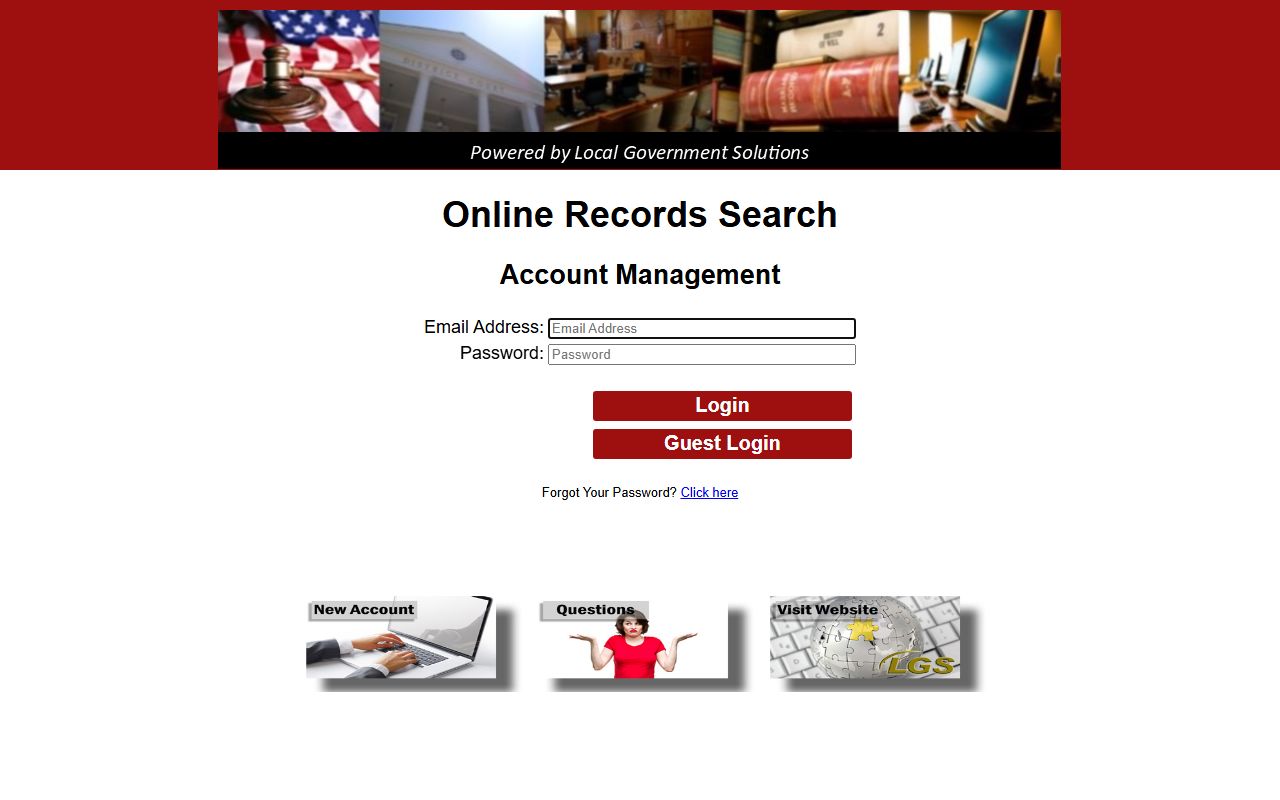
The portal is best used with a stable name spelling or case number from the clerk or docket record.
Hardin County Misdemeanor Records
The Hardin County Clerk is the first stop for misdemeanor court records after a jail arrest. The office is on the first floor of the Hardin County Courthouse, Suite B-110, 300 W Monroe, Kountze, TX 77625, with mailing address PO Box 38. The clerk phone is 409-246-5185, and the office hours are Monday through Friday, 8:00 a.m. to 5:00 p.m. The County Court criminal docket page lists docket resources and gives phone 409-246-5120. The clerk page also says misdemeanor defendants may contact the office to check a court date or pay fines and court costs by phone with a credit card, with added card fees.
| Channel | Hardin County detail |
|---|---|
| County Clerk | Misdemeanor records, court dates, fines, and court costs. |
| Portal | Official LGS Online Solutions ORS portal linked by the clerk page. |
| County Clerk phone | 409-246-5185. |
| County Court phone | 409-246-5120. |
| Hours | Monday through Friday, 8:00 a.m. to 5:00 p.m. |
| Office | Hardin County Courthouse, Suite B-110, 300 W Monroe, Kountze, TX 77625. |
Hardin County Felony Court Records
Felony court records after a jail arrest do not always appear in the misdemeanor clerk workflow. The 88th District Attorney page names Rebecca Walton as District Attorney and lists the office at the Hardin County Courthouse, 2nd Floor, 300 West Monroe Street, PO Box 1409, Kountze, TX 77625. The phone is 409-246-5160. The County Attorney page names Matthew Minick and lists phone 409-246-5165 for county-attorney matters. These offices are prosecutor channels, not general online case-search portals.
88th District Attorney
Rebecca Walton
300 West Monroe Street, 2nd Floor
Kountze, TX 77625
409-246-5160
Hardin County Attorney
Matthew Minick
300 West Monroe Street, 1st Floor
Kountze, TX 77625
409-246-5165
The Hardin County District Attorney page identifies the felony prosecution office used after a qualifying arrest.
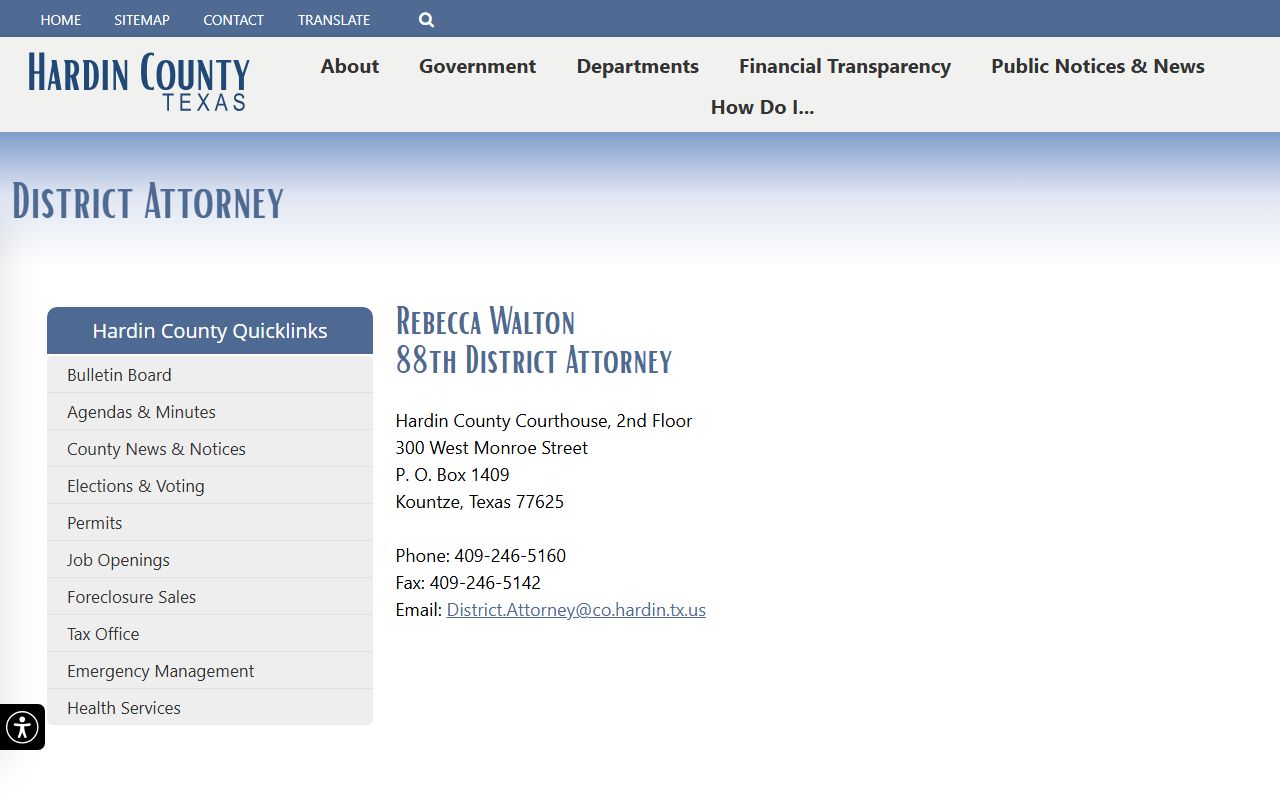
Prosecutor contact can clarify routing, but filed case records still need to be confirmed through the court or clerk channel that holds the official case file.
Charging Records After Jail Arrest
Hardin County court records after a jail arrest may begin with different charging documents. A complaint is a sworn accusation or charging paper used in many criminal matters. An information is a prosecutor-filed charging document, often used in misdemeanors and some felony contexts where allowed. An indictment is a grand jury charging document, commonly tied to felony prosecution. The final filed charge can differ from the arrest label on the jail roster.
| Document | Who files or returns it | Common use | What to check |
|---|---|---|---|
| Complaint | Officer, complainant, or prosecutor route | Often starts misdemeanor or probable-cause paperwork | Named offense, date, and sworn facts. |
| Information | Prosecutor | Common for misdemeanor filings and some Texas felony postures | Filed charge, count, and court case number. |
| Indictment | Grand jury | Serious felony prosecution | Returned counts, offense level, and arraignment setting. |
Hardin County Charge Status
A charge status is the court record's current posture. It is not the same thing as a jail hold, and it is not the same thing as guilt. Charges may be pending while the case is active. They may be amended if the prosecutor changes the count or language. They may be reduced to a lower offense, dismissed by the court or prosecutor, or resolved by plea, trial, diversion, or another disposition. The Hardin County County Court docket page is useful because it posts dated criminal docket links for arraignment, announcement, and pretrial diversion matters.
| Status | What It Means |
|---|---|
| Pending | The court case or charge is still active and has not reached final disposition. |
| Amended | The filed wording, count, or offense level changed after the original charge. |
| Reduced | The charge moved to a lower offense or lesser included offense. |
| Dismissed | The charge ended without a conviction on that count. |
| Disposition | The court's final outcome, such as conviction, dismissal, acquittal, or deferred result. |
Bond Records After Arrest
Bond is usually addressed early after a Hardin County jail arrest. Texas Code of Criminal Procedure Chapter 17 governs bail and bond decisions. The local sheriff jail page has a specific payment rule: fines or cash bonds are accepted only by cashier's check or money order for the exact amount. No cash is accepted and no change is available. Surety bonds may be made through a local bonding company, but the jail will not recommend a company. A no-bond hold, detainer, warrant from another place, parole or probation hold, federal hold, or ICE detainer can block release even when a local payment appears possible.
| Bond Type | Hardin County and Texas meaning |
|---|---|
| Cash bond | Local jail accepts exact cashier's check or money order only for fines or cash bonds. |
| Surety bond | Posted through a local bonding company; the jail cannot suggest a company. |
| PR bond | Personal recognizance release based on a promise to appear when authorized by the court. |
| No-bond hold | Custody continues until a court or agency removes the hold or changes the order. |
Warrants and Arrest Records
No official Hardin County sheriff active-warrant searchable database was located in the research pass. A warrant can still lead to booking and then to court records after arrest. An arrest warrant is a judge or magistrate order to arrest on an alleged offense. A bench warrant is often tied to a missed court date or failure to comply. A search warrant authorizes a search, not custody status. A fugitive or other-agency warrant can hold a person for another jurisdiction.
For warrant direction, call the sheriff main line at 409-246-5100 or the Records Division at 409-246-5236. The jail desk at 409-246-5105 can help with current custody, but it is not a complete active-warrant database. People who believe they may have a warrant should speak with an attorney or the issuing court before appearing in person without advice.
Note: A roster hit after a warrant arrest confirms jail custody, but the issuing court controls many warrant-status questions.
Charge vs Conviction Records
Hardin County court records after a jail arrest must be read by stage. A booking charge or filed charge is an accusation. A conviction is a final court result after a plea, verdict, or other adjudication. Court records can show both, but readers should not collapse them into the same fact. This is especially important when a charge was dismissed, reduced, amended, or resolved by a diversion path.
| Question | Charge | Conviction |
|---|---|---|
| Stage | Allegation after arrest or filing | Final court outcome on a count |
| Proof | Probable cause or prosecutor filing standard | Plea, verdict, or judgment standard |
| Can change? | Yes, it can be amended, reduced, added, or dismissed | Changes only through court relief, appeal, or later order |
Sealed and Expunged Records
Texas record relief can affect public access after a Hardin County arrest. Texas Code of Criminal Procedure Chapter 55 governs expunction, which can allow qualifying arrest records to be removed or treated as though the arrest did not occur for many public purposes. Sealing or nondisclosure is different. It hides some records from public view but may still allow access by law enforcement or authorized agencies. The county pages did not publish a local shortcut for removing a booking record or mugshot after expunction, so official court orders should be used with the relevant agency.
| Question | Sealed | Expunged |
|---|---|---|
| Public access | Restricted from ordinary public view | Removed or treated as not existing for many public uses |
| Agency access | Some agencies may still access it | Very limited after a valid order |
| Best proof | Court order of nondisclosure or sealing | Court order of expunction under Texas law |
Limits on Court Records After Arrest
Texas Government Code Chapter 552 gives a public right to request government records, but it also contains exceptions. Section 552.108 can allow withholding of certain law-enforcement or prosecutor information when release would interfere with detection, investigation, or prosecution. Local Government Code Chapter 351 frames county jail duties, Government Code Chapter 511 frames jail standards, and Code of Criminal Procedure Chapter 2 supports the arrest and magistrate pathway. Juvenile records, sealed records, expunged records, safety-sensitive records, and some privacy-protected information can be restricted.
Important: Court records after arrest may be incomplete online; verify filed charges, hearings, and disposition with the clerk or court.